
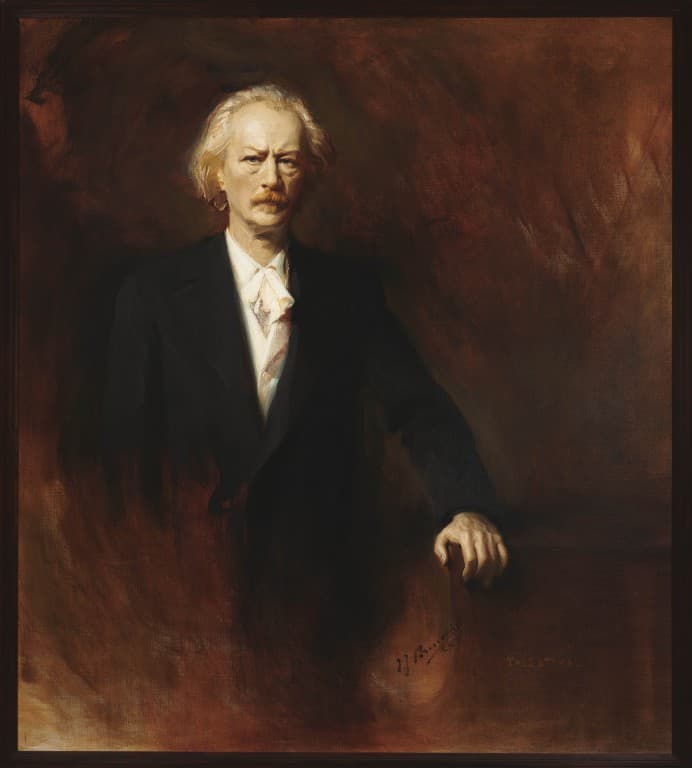
Permanent exhibition from 26 April 2024
The exhibition presents over 220 works of art and memorabilia related to Ignacy Jan Paderewski, one of the greatest Polish musicians and statesmen of the 20th century. Objects tell the story of his life. His most important state decorations and medals portray him as a distinguished politician, committed to Poland’s efforts to regain independence. Musical instruments, including a Steinway & Sons grand piano, commemorative batons, and cups with inscriptions from symphony orchestras, recall Paderewski’s musical genius, while a valuable collection of porcelain from China and Japan, well-worn travel trunks, and a set of decorative souvenir spoons reflect his interests and travels to various corners of the world.
Everyday objects offer a glimpse of Helena and Ignacy Paderewski’s domestic and family life: refined tea services and crystal bowls, a silver tureen by Tiffany, a typewriter, a wallet and a visiting-card case decorated with filigree. Even miniature carnelian figures of a hen and a rooster play a part in the story of the eminent politician and musician: his wife was a passionate poultry keeper. The exhibition also includes gifts Paderewski received from friends and from various organisations in recognition of his great talent and in gratitude for his work for independence.
The objects gathered in the exhibition are a testamentary bequest that Paderewski donated to the National Museum in Warsaw in 1930. This gift, a selection of which can be viewed at the Museum of Interiors in Otwock Wielki, was, in addition to its material and historical value, also an act of patriotism. On 23 September 1940, in his last radio address before leaving Switzerland for the United States, Paderewski said: “I devoted my life to my homeland. I served it with all my heart and all my strength […]”.


The display
Little is known about the eighteenth-century furnishings of the palace. From the time of its splendour, only the wall decorations on the first floor survive. The vestibule (preceding the Ballroom) resembles a grotto, glittering in the sunlight thanks to glass fragments set into the plaster. The walls of the rooms on the left of the main block are covered by an exceptional, well-preserved set of paintings from the first quarter of the eighteenth century. Art historians and scholars of Polish architecture and sculpture have recently tended to the view that the designer of these decorations may have been Tylman van Gameren (1632–1706), the distinguished Dutch-born architect who worked in Poland in the second half of the seventeenth century and the beginning of the eighteenth.
The palace interiors were restored after the Second World War. In the early 1970s, when the palace became a government residence, the wall paintings were conserved for the first time and recovered their former brilliance. Since 2004 the ensemble has been in the care of the National Museum in Warsaw, which established its branch here — the Museum of Interiors. The display draws on the Museum’s own rich collections: historic-style interior arrangements, complemented by early instruments. It also houses a valuable collection of memorabilia of the great pianist, politician and patriot Ignacy Jan Paderewski (1860–1941) from his Swiss home at Riond Bosson, among them the famous Steinway piano. The permanent display is supplemented by thematic presentations related to the history of the palace and the collections shown here.
You will see
The park
It is known that in the seventeenth century spreading oaks grew on the site of the present palace-and-park ensemble at Otwock Wielki. The palace island was formed artificially at the turn of the seventeenth and eighteenth centuries by cutting off a spit of land that jutted into an old bed of the Vistula. The Baroque layout of the park, with avenues radiating in a star, is still legible. Today it is dominated by ancient limes, hornbeams and elms. Beyond the island, the eighteenth-century park was completed by oaks planted in rows to the east, while to the west there was to be a game park, a kitchen garden and orchards. From time to time, when the lake waters recede a little in summer, fragments of carved stone park decoration are found — among them balusters that framed the terrace, masks and terracotta leaves.
After a walk you can rest in the palace café, which serves excellent cakes, and look at works by artists from the region.
Every year in summer, on every Sunday in July and August at 5.00 p.m., classical concerts are held in the park, with free admission. Music sounds wonderful in this setting and is a perfect complement to a weekend outing.
Digital NMW
Discover the digital collections of the National Museum in Warsaw and explore thousands of works of art — from painting and sculpture to prints, photography and decorative arts.
Plan your visit


